
Table of Contents
A remote control slope mower is designed to maintain vegetation where steep ground, uneven surfaces or nearby hazards make conventional mowing difficult. Removing the operator from the mower can reduce direct exposure to rollover zones, unstable banks and moving cutting components, but remote operation does not make every slope suitable for mowing.
Machine stability depends on the relationship between center of gravity, track contact, body width, cutting-deck position, travel direction and ground condition. Safe operation also depends on reliable controls, functional guards, controlled speed, clear visibility and a correctly prepared work area.
This guide explains:
- How center of gravity influences mower stability
- Why track design matters on slopes
- The difference between a stated slope rating and real working conditions
- How travel direction and steering affect traction
- Which remote-control and emergency-stop features should be checked
- Why terrain inspection remains necessary
- How to compare slope mower specifications before selection
What Is a Remote Control Slope Mower?
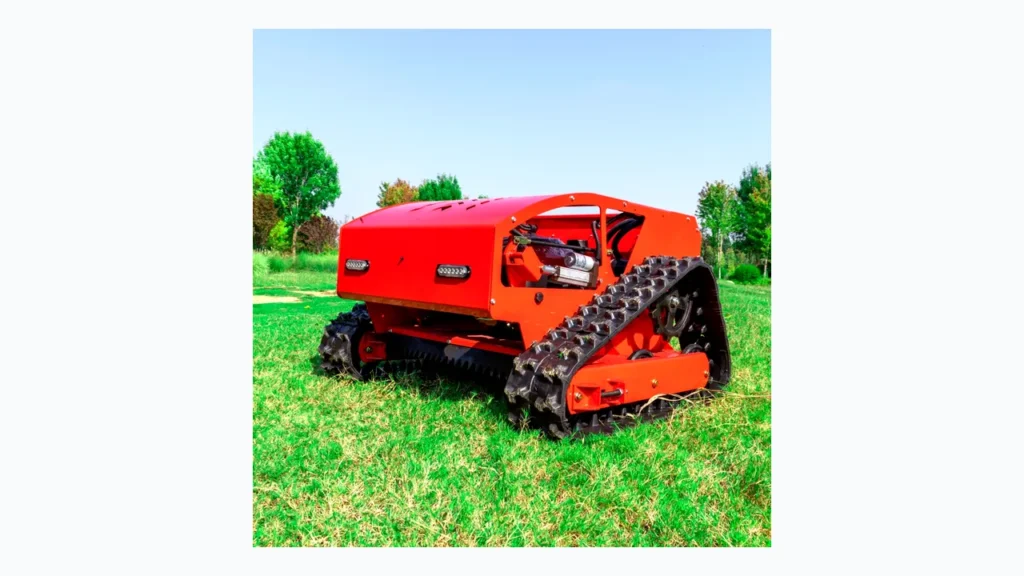
A remote control slope mower is a powered cutting machine operated through a handheld transmitter rather than by a person riding directly on the equipment. Many commercial models use crawler tracks and a relatively low-profile body to improve traction and access on sloped or irregular terrain.
The operator actively controls direction, speed and cutting functions while observing the mower from a separate position. This differs from an autonomous robotic mower, which follows programmed boundaries, mapping or sensor-based navigation.
The Mingyang remote control lawn mower range includes crawler models intended for slopes, farms, orchards, solar installations and other difficult vegetation-management environments.
Remote Control Does Not Eliminate Mowing Hazards
The operator may be physically separated from the mower, but several hazards remain:
- Machine sliding or overturning
- Thrown stones, wire or branches
- Contact with rotating blades
- Loss of visibility
- Control-signal interruption
- Hidden holes and soft ground
- Movement toward traffic or water
- People or animals entering the work area
- Fire or fuel hazards
- Unexpected engine or hydraulic failure
Safe performance comes from combining suitable machine design with correct worksite assessment and operation.
Center of Gravity and Slope Stability
The center of gravity is the theoretical point through which the machine’s combined weight acts. Its position changes with machine design, fuel level, cutting-deck movement, attachments, terrain angle and dynamic forces during travel.
A low center of gravity generally improves slope stability because the machine’s mass remains closer to the supporting surface. However, a low-profile body alone does not guarantee that a mower will remain stable on every incline.
Supporting Footprint
The supporting footprint is the area between the track contact points. When the mower is level, the center of gravity normally remains well within this area.
As the slope angle increases, the line of force created by the machine’s weight moves closer to the downhill edge of the supporting footprint. If it moves outside that area, the risk of overturning increases.
Sudden turns, impacts, holes and rapid deceleration can create additional dynamic forces, causing instability before the machine reaches its theoretical static limit.
Machine Width
A wider track stance can provide a broader supporting base. This is particularly relevant during cross-slope operation, when the uphill and downhill tracks are at different elevations.
Width must be balanced with access requirements. A very wide mower may be stable in an open area but unable to work between orchard rows, solar-panel supports or narrow entrances.
Machine Height
A taller machine generally places more mass above the ground. A low-profile crawler design can help reduce this effect and also improve clearance beneath branches and selected solar structures.
The complete machine height should be evaluated together with track width, weight distribution and cutting-deck position.
Why Crawler Tracks Matter on Slopes
Crawler tracks provide a longer contact surface than small wheels. This can improve flotation and allow the machine’s weight to be distributed across a broader section of ground.
Tracks can also provide useful traction on grass, compact soil and moderately uneven terrain. Their actual performance depends on tread design, track tension, surface material and moisture.
Ground Contact
A track only provides traction where it remains in contact with the terrain. Stones, holes, ridges or vegetation buildup can reduce effective contact and place more load on a smaller part of the track.
Before entering a slope, operators should look for:
- Ruts and depressions
- Loose soil
- Exposed roots
- Large stones
- Eroded channels
- Wet clay
- Thick vegetation mats
- Hidden branches
- Unsupported bank edges
A crawler system cannot compensate for severe ground failure or an undercut slope.
Track Tension
Incorrect track tension can affect steering, wear and reliability. A track that is too loose may derail, while excessive tension can increase stress on drive and supporting components.
Track tension should be checked according to the operating manual. Stones, wire and compacted vegetation should also be removed from the undercarriage before they interfere with track movement.
Wet Grass and Mud
Wet grass can act as a low-friction layer between the tracks and soil. Mud may clog the tread and reduce its ability to grip the ground.
A mower that performs normally on a dry slope may slide on the same incline after rain, irrigation or morning dew. The practical working angle must therefore be adjusted to current conditions.
Working Slope vs Static Stability
Slope mower specifications may refer to maximum working slope, climbing capability, gradeability or static stability. These terms should not be treated as interchangeable.
| Term | General meaning | Limitation |
|---|---|---|
| Maximum working slope | Manufacturer’s stated limit for operation under defined conditions | Actual terrain may require a lower angle |
| Gradeability | Ability to travel up a specified incline | Does not automatically define safe cross-slope mowing |
| Static stability | Angle at which a stationary machine remains stable under test conditions | Does not account for turning, holes or dynamic movement |
| Climbing angle | Maximum incline the drive system may climb | Traction and stability may impose separate limits |
| Recommended operating slope | Normal operating range stated by the manufacturer | Still depends on site inspection and machine condition |
The HT800A Remote Control Crawler Slope Mower has a stated maximum working slope of 45 degrees. This should be treated as a machine limit under appropriate conditions—not as the normal target for every site.
Wet vegetation, loose soil, cross-slope travel, hidden holes and sudden steering inputs can reduce the safe operating angle.
Travel Direction Changes Stability
A slope can be approached in three general ways:
- Travelling up and down
- Travelling across the slope
- Travelling diagonally
Each direction creates different stability and traction conditions.
Up-and-Down Travel
Travelling directly up or down a slope keeps both tracks at a similar elevation, but changes the machine’s front-to-rear weight distribution.
During downhill travel, braking and stopping behavior become especially important. The machine should not be allowed to accelerate beyond a controlled speed.
When travelling uphill, track grip and engine or drive capacity must be sufficient. Operators should avoid reaching a point where the mower cannot continue upward or reverse in a controlled manner.
Cross-Slope Travel
Cross-slope movement places the tracks at different elevations and shifts the machine’s weight toward the downhill side. This can increase rollover risk, particularly when the mower crosses a hole, ridge or soft patch.
The operator should remain aware of the mower’s downhill path and avoid standing directly below it.
Diagonal Travel
Diagonal travel combines front-to-rear and side-to-side loading. It may also produce uneven track grip, especially when one track crosses a different surface.
The operating manual should determine permitted travel directions. Operators should not improvise a route simply because it appears shorter.
Controlled Speed and Steering
Stability is not determined only by the mower’s stationary geometry. Movement creates dynamic forces that can shift load and reduce track contact.
Sudden Turns
A rapid turn on a cross-slope can transfer weight toward one track and reduce grip on the other. Sharp steering may also disturb soil or cause the track to slide over wet grass.
Direction changes should remain gradual and controlled. If a turn cannot be completed with adequate clearance, the mower should be repositioned using a safer route.
Starting and Stopping
Rapid acceleration or braking can affect stability and traction. The operator should confirm how the mower responds on level ground before moving onto a slope.
Stopping distance may increase on wet or loose terrain. A slope should not be entered unless sufficient space exists to stop or redirect the machine safely.
Cutting Load
Tall, dense or wet vegetation increases resistance at the cutting deck. If the mower slows significantly, the operator may be tempted to use more travel speed or repeated steering movements.
A safer approach is to reduce travel speed, increase the initial cutting height or divide the work into multiple passes.
Remote-Control Reliability
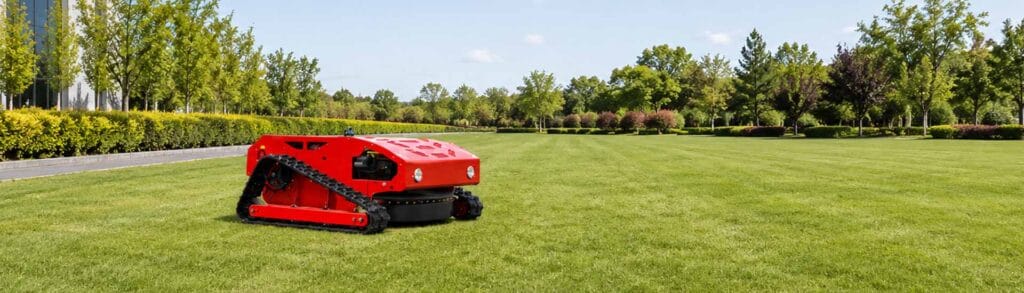
The remote-control system is a core safety component. It should provide predictable commands and allow the mower to stop if control is interrupted.
Important functions may include:
- Forward and reverse travel
- Left and right steering
- Cutting-system engagement
- Cutting-height adjustment
- Engine start and stop
- Emergency stop
- Signal-status indication
- Battery-level indication
- Loss-of-signal response
Available controls vary by model and should be confirmed from the operating manual.
Control Range Is Not the Recommended Working Distance
The HT800A lists remote operation of up to 680 m under appropriate conditions. This describes communication capability, not the distance at which the operator should normally mow.
The operator must still recognize:
- Changes in the slope
- People or animals entering the area
- Stones and fixed obstacles
- Track movement
- Deck blockage
- Smoke, leakage or unusual vibration
- The mower’s precise distance from edges
A shorter working distance with an unobstructed view is generally more useful than operating near the maximum signal range.
Line of Sight
Buildings, trees, terrain crests and solar panels may block the operator’s view even when the control signal remains active. The mower should not continue into an area where its travel path and surrounding hazards cannot be observed.
The operator may need to stop and move to another safe position before proceeding.
Emergency Stop
The emergency-stop function should be tested before work begins. Operators must know whether it stops only the cutting system, stops machine travel or shuts down the engine.
After an emergency stop, the cause should be identified before operation resumes.
Cutting Deck and Blade Protection
The cutting system contains rapidly rotating components capable of discharging stones, metal and woody debris. A remote control slope mower therefore requires intact guards, covers and discharge protection.
The OSHA-supported mowing safety guidance emphasizes pre-start inspection, functional guards, removal of debris from the work area and keeping bystanders away.
Blade Condition
Worn, cracked, bent or improperly balanced blades can increase vibration and reduce cutting quality. Blade fasteners must remain secure, and replacement components should match the manufacturer’s specifications.
The engine and cutting system must be stopped before blade inspection or cleaning.
Deck Height
A low cutting height may produce a closely maintained result, but it also increases the likelihood of blade contact with soil, stones and hidden objects.
The HT800A provides a 20–180 mm cutting-height range with remote deck adjustment. On neglected or poorly visible ground, a higher first pass can expose hidden obstacles before a lower finishing pass is considered.
Deck Blockage
Wet grass and dense vegetation may accumulate inside the deck. Blockage should never be cleared while the blade is moving or the machine could restart unexpectedly.
Follow the shutdown and isolation procedure provided in the operating manual before approaching the cutting system.
Comparing Wheel and Crawler Slope Mowers
| Feature | Wheeled mower | Crawler slope mower |
|---|---|---|
| Ground-contact area | Smaller contact patches | Longer track-contact area |
| Hard-surface travel | Generally efficient | May increase track wear |
| Soft-ground flotation | Depends on tire width | Generally better |
| Turning behavior | May require a wider arc | Can turn in a compact area |
| Cross-slope grip | Depends heavily on tires and terrain | Tracks may provide broader contact |
| Maintenance focus | Tires, hubs and steering | Tracks, tension, rollers and drive system |
| Turf disturbance | Depends on tires and turning | Sharp track turns may still mark turf |
| Rough-terrain access | Limited by tire traction and clearance | Usually more suitable for irregular ground |
A crawler slope mower is not automatically the best solution for every site. Firm, level and frequently maintained ground may not require a tracked system. The machine should be matched to the most demanding recurring terrain rather than an occasional extreme condition.
Selecting a Suitable Cutting Width
Cutting width influences productivity, access and maneuverability.
A wider cutting deck covers more ground in each pass, which can reduce the number of passes on open slopes. However, it requires more space around trees, posts, barriers and structures.
A narrower machine may be easier to use in orchards, vineyards, solar arrays and narrow drainage corridors.
Mingyang provides two principal crawler-mower formats:
| Model | Cutting-width format | Main selection advantage |
|---|---|---|
| HT550A Remote Control Crawler Lawn Mower | 550 mm | Maneuverability in restricted areas |
| HT800A Remote Control Crawler Slope Mower | 800 mm | Wider coverage on larger slopes |
Cutting width should be compared with the narrowest entrance, row spacing, obstacle clearance and required daily coverage.
Worksite Inspection Before Mowing
Every site should be assessed before the mower enters the slope.
Terrain Inspection
Walk the work area where it is safe to do so and identify:
- Maximum and changing slope angles
- Soft, waterlogged or eroded ground
- Hidden holes and ruts
- Rocks and exposed roots
- Drop-offs and unsupported edges
- Water, roads and structures
- Safe operator positions
- Possible recovery routes
A slope measurement taken at one point does not represent the entire work area. Short sections may be steeper or more unstable than the average slope.
Vegetation Inspection
Tall grass can hide holes, wire, concrete, branches and other debris. The first pass should be conservative when ground visibility is limited.
Thick woody stems may exceed the mower’s intended cutting capacity. A lawn mower should not be used as forestry equipment unless the specific cutting system is designed for that material.
Exclusion Zone
The exclusion zone should account for both machine movement and thrown objects. Its size depends on the mower, blade system, terrain, nearby roads and manufacturer instructions.
Bystanders, animals and vehicles must remain outside the controlled area.
Daily Pre-Operation Checklist
| Component | Inspection points |
|---|---|
| Remote controller | Battery, switches, signal and emergency stop |
| Cutting system | Blade condition, mounting and free movement |
| Cutting deck | Guards, covers, adjustment and blockage |
| Tracks | Tension, damage, wear and trapped debris |
| Drive system | Abnormal noise, leakage and response |
| Engine | Oil, fuel, cooling and visible damage |
| Electrical components | Wiring, plugs and protective covers |
| Fasteners | Loose or missing bolts |
| Safety labels | Present and readable |
| Work area | Slope, holes, debris, traffic and bystanders |
Any safety-related defect should be corrected before operation. Temporary repairs that change guards, controls or emergency-stop behavior should not be used.
Operator Position and Visibility
Remote control allows the operator to choose a safer position, but a poor position can introduce new risks.
The operator should:
- Maintain a clear view of the mower
- Avoid standing directly downhill
- Keep away from discharge paths
- Maintain stable footing
- Avoid moving backward without checking the area
- Stay clear of traffic and water edges
- Keep the remote-control unit secure
- Prevent unauthorized people from operating the machine
When working near a road, a second person may be needed for traffic or site control according to local requirements.
Working Around Solar Panels and Fixed Structures
Solar farms are a common application because low panels and closely spaced supports can limit conventional equipment.
Before mowing:
- Confirm mower height against panel clearance
- Identify exposed cables and grounding components
- Mark low support members
- Check row width and turning areas
- Confirm emergency access routes
- Prevent blade discharge toward sensitive equipment
- Avoid track contact with cables and protective conduits
Remote operation can improve visibility around panel supports, but the operator should stop and reposition rather than allow the mower to disappear behind structures.
Transporting a Crawler Slope Mower
Transport safety begins with the actual machine weight and dimensions. Trailer rating, ramp strength and tie-down capacity must match the mower.
Before loading:
- Clean heavy mud and vegetation from the tracks.
- Confirm that ramps are secured.
- Align the machine with the trailer.
- Use slow, controlled travel.
- Keep bystanders away.
- Lower the cutting deck into the specified transport position.
- Shut down the machine before securing it.
- Use approved tie-down points.
- Protect the remote controller during transport.
Wet steel ramps can reduce track grip. Loading should not proceed until traction and alignment can be maintained.
Choosing a Configuration for Different Markets
A mower configuration should reflect local terrain, vegetation, service conditions and regulatory requirements.
Useful information to provide includes:
- Typical working slope
- Maximum slope encountered
- Cutting-area dimensions
- Grass and brush type
- Required cutting height
- Narrowest access width
- Daily operating duration
- Engine preference
- Destination country
- Required manuals and labels
- Spare-parts expectations
- Branding and packaging requirements
Mingyang’s OEM and ODM machinery services may include engine configurations, colors, logos, labels and packaging. Available options should be confirmed for the selected model before production.
FAQ
Does remote control make a slope mower completely safe?
No. Remote control separates the operator from the machine but does not eliminate sliding, rollover, blade, projectile or terrain hazards. Safe operation still requires a suitable mower, worksite inspection, an exclusion zone, clear visibility, tested controls and conservative operation within the manufacturer’s limits.
Is the maximum slope rating suitable for every type of ground?
No. A stated working slope normally assumes defined machine and surface conditions. Wet grass, loose soil, mud, stones, cross-slope movement, hidden holes and track wear may reduce practical stability. Operators should assess the complete site and use a lower operating angle whenever conditions are uncertain.
Is a crawler mower always more stable than a wheeled mower?
Crawler tracks generally provide a longer contact area and useful flotation on soft or uneven ground. Stability still depends on track width, center of gravity, slope direction, machine speed and surface grip. A tracked machine can slide or overturn if it is operated beyond actual terrain and design limits.
Where should the operator stand when mowing a slope?
The operator should maintain a clear line of sight from a stable position outside the mower’s possible travel and discharge paths. Standing directly downhill should be avoided because the machine may slide in that direction. The correct position also depends on traffic, water, structures and manufacturer instructions.
What should be inspected before using a remote control slope mower?
Inspect the remote controller, emergency stop, blades, deck, guards, tracks, fasteners, engine, wiring and visible leakage. Walk the work area to identify stones, wire, holes, erosion and changing slopes. Confirm that bystanders are excluded and that the operator can see the complete mowing route.
Conclusion
The stability of a remote control slope mower is created by several connected factors. A low center of gravity, suitable track width, reliable ground contact and controlled travel can support operation on inclines, but none of these features works independently of terrain and operator judgment.
The stated maximum working slope should never replace a real site assessment. Wet grass, loose soil, hidden depressions, cross-slope travel and abrupt steering can make a lower incline more hazardous than a clean, firm test surface.
Models such as the HT550A and HT800A address different access and coverage requirements. The narrower HT550A is suited to restricted spaces, while the HT800A combines an 800 mm cutting width, remote deck adjustment and a stated maximum working slope of 45 degrees for larger slope applications.
A properly selected remote control lawn mower can reduce the need for operators to ride directly on difficult terrain. Safe and stable performance still depends on clear visibility, functional controls, intact guards, correct track maintenance and operation within the real limits of the site.