
Table of Contents
A large excavator may offer greater digging depth and lifting capacity, but size becomes a disadvantage when a project involves narrow gates, confined yards, greenhouses, small farms or utility trenches close to existing structures. In these conditions, a 1 ton mini excavator can provide a more practical balance between access, digging ability and transport convenience.
However, machine weight alone does not determine whether a compact excavator is suitable. Chassis width, track adjustment, digging range, hydraulic configuration, stability and attachment compatibility must all be evaluated against the actual working environment.
This guide explains:
- How to determine whether a one-ton machine is large enough for the planned work
- Which dimensions matter when entering narrow jobsites
- How digging depth, reach and unloading height affect productivity
- Why track width, counterweight and blade position influence stability
- Which engine and attachment options should be confirmed
- What to inspect before selecting a model for construction, landscaping or farm maintenance
What Is a 1 Ton Mini Excavator?
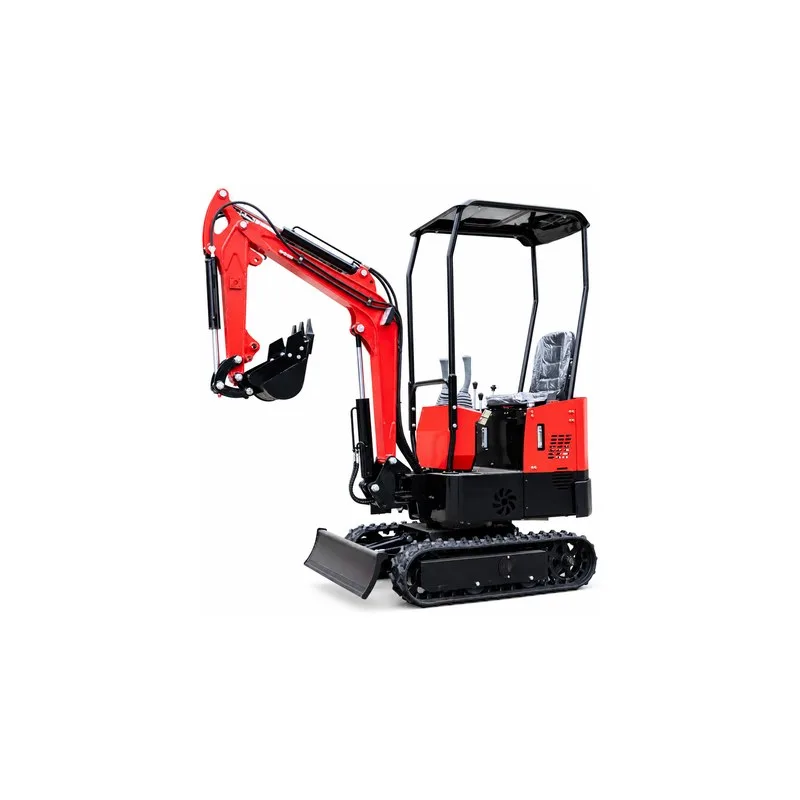
A 1 ton mini excavator is a compact crawler excavator with an operating weight close to 1,000 kg. It normally combines a rotating upper structure, boom, arm, bucket, dozer blade and rubber or steel track system within a relatively narrow machine body.
Its purpose is not to replace a medium or large excavator in heavy earthmoving. Instead, it performs controlled digging, trenching, grading and material handling in locations where machine access and ground disturbance are important considerations.
The broader mini excavator range includes machines in several weight classes. A one-ton model generally prioritizes maneuverability and transport convenience, while larger machines provide greater reach, lifting stability and attachment capacity.
Compact Size Does Not Mean Universal Suitability
A one-ton excavator is well suited to light excavation, but it still has operating limits. Dense clay, large rocks, deep foundations and demanding demolition may require a heavier machine with greater breakout force and hydraulic capacity.
The correct approach is to match the excavator to the most frequent task rather than selecting the smallest machine only because it can enter the site.
When Does a 1 Ton Mini Excavator Make Sense?
Small excavators are most effective when access limitations and precise movement matter more than maximum production volume. They are commonly considered for landscaping, residential construction, drainage, farm maintenance and utility work.
Landscaping and Garden Work
A compact machine can enter gardens and yards where a standard excavator would damage surrounding surfaces or have insufficient turning space. Typical work includes planting holes, small ponds, drainage channels, stump removal and soil relocation.
Narrow tracks and a compact rear turning radius also make it easier to work close to fences, walls and established landscape features.
Utility and Drainage Trenches
Water lines, electrical conduits, irrigation pipes and shallow drainage systems often require controlled trenches rather than high-volume excavation. A one-ton machine can perform these tasks efficiently when its digging depth and bucket width correspond to the required trench dimensions.
Before starting work, underground services must be identified and the excavation area assessed. General ISO earth-moving machinery standards cover safety requirements for hydraulic excavators and related equipment, but operators must also comply with local jobsite and excavation regulations.
Farm and Greenhouse Maintenance
Farms frequently contain narrow tracks, irrigation systems, livestock areas and structures that restrict access. A small crawler excavator can support ditch cleaning, drainage installation, soil handling and routine property maintenance.
Inside or around greenhouses, machine width, turning clearance, ventilation and surface conditions should be checked carefully before operation.
Small Construction Projects
A compact excavator may support light foundation preparation, site cleaning, shallow trenching and material handling around residential or small commercial projects. It is particularly useful during later construction stages when larger machines can no longer move freely between completed structures.
Key Specifications to Compare Before Choosing
Machine labels such as “one ton” provide only a general size category. Two models with a similar operating weight may have different dimensions, digging ranges and configurations.
| Specification | Why It Matters | What to Confirm |
|---|---|---|
| Operating weight | Affects transport, ground pressure and stability | Whether listed weight includes the bucket, fluids and optional equipment |
| Overall width | Determines access through gates and passages | The machine’s widest fixed point |
| Track gauge | Influences access and operating stance | Whether the track system is fixed or adjustable |
| Maximum digging depth | Determines trench and foundation capability | Actual depth required for the planned application |
| Excavation radius | Affects how far the machine can work without repositioning | Available work area and obstacle placement |
| Unloading height | Determines whether material can be loaded into a truck or container | Height of the receiving vehicle or pile |
| Bucket capacity | Influences production and hydraulic load | Material density and required trench width |
| Rated power | Affects hydraulic and travel performance | Engine configuration and local service availability |
| Swing radius | Determines clearance around the machine | Distance from walls, fences and workers |
| Auxiliary hydraulics | Controls powered attachment compatibility | Required flow, pressure and connections |
Access Width Should Be Measured First
Before selecting a mini excavator for tight spaces, measure every point along the access route—not only the entrance gate. The route may include corners, steps, temporary structures, low branches, pipes or narrow spaces between buildings.
The machine’s track width is important, but mirrors, control levers, blade ends and upper-structure overhang may also affect passage. A clearance margin should be retained rather than choosing a machine that only just matches the opening.
The HT10B 1 Ton Mini Excavator has a chassis width of 896 mm and an adjustable track gauge of 830–1,000 mm. The narrow setting supports restricted access, while the wider stance can improve the operating footprint after the machine enters the work area.
Digging Depth Must Match the Real Project
A deeper specification is not automatically better if the machine is mainly used for planting, shallow drainage or light landscaping. Extra digging capacity often comes with greater machine weight and larger dimensions.
The HT10B provides a maximum digging depth of 1,650 mm, a maximum vertical digging depth of 1,375 mm and a maximum excavation radius of 2,850 mm. These figures should be compared with the required trench depth, working position and safe distance from the excavation edge.
Unloading Height Is Often Overlooked
Excavation is only one part of the working cycle. The machine must also place soil where it can be removed or reused.
If material needs to be loaded into a vehicle, compare the excavator’s unloading height with the height of the truck or dumper body. The HT10B has a maximum unloading height of 1,850 mm. For higher receiving vehicles, repositioning, an intermediate pile or a different machine configuration may be necessary.
Stability and Maneuverability in Restricted Areas
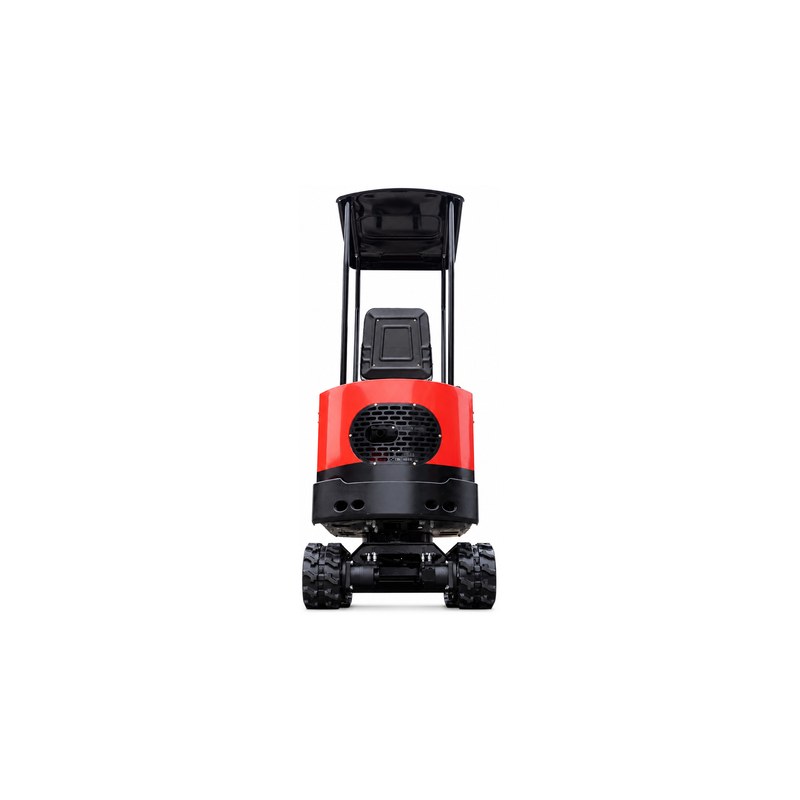
Compact dimensions improve access but reduce the size of the machine’s supporting footprint. Stable operation therefore depends on track position, ground conditions, blade placement, load direction and operator technique.
Adjustable Tracks
An adjustable track system allows the undercarriage to contract for access and expand for operation. The wider position generally provides a broader stance, although it does not remove the need to assess slope, soil strength and load direction.
Tracks should be fully positioned according to the manufacturer’s instructions before digging. Operators should not assume that a machine is stable simply because it is operating on apparently level ground.
Rear Counterweight
A counterweight helps balance forces created by the boom, arm, bucket and lifted material. The HT10B uses an additional 100 kg rear counterweight to support balance during digging and material handling.
Counterweight does not increase the machine’s rated capacity without limit. Bucket size, attachment weight, digging radius and ground inclination continue to affect stability.
Dozer Blade Position
The dozer blade can support light grading and site cleaning, but it also helps stabilize the excavator when positioned correctly. Its orientation relative to the digging direction changes the supporting geometry of the machine.
The HT10B blade length can be adjusted from 84 to 105 cm. Operators should follow the operating manual when using the blade for support, grading or backfilling.
Swing Boom for Work Near Obstacles
A swing boom allows the digging equipment to move laterally without repeatedly repositioning the entire machine. This is valuable when excavating beside walls, fences, foundations and existing utility routes.
An optional HT10B boom can deflect up to 60 degrees to either side. This configuration can make trench alignment more practical in confined areas, but clearance around the boom, bucket and upper structure must still be maintained.
Understanding the HT10B Working Range
The Mingyang HT10B is designed around restricted-access excavation and light construction work.
| HT10B parameter | Specification |
|---|---|
| Operating weight | 1,000 kg |
| Overall dimensions | 2,775 × 930 × 2,219 mm |
| Chassis width | 896 mm |
| Adjustable track gauge | 830–1,000 mm |
| Bucket capacity | 0.025 m³ / 120 kg |
| Standard bucket width | 380 mm |
| Maximum digging depth | 1,650 mm |
| Maximum excavation radius | 2,850 mm |
| Maximum unloading height | 1,850 mm |
| Rear platform turning radius | 784 mm |
| Travel speed | 1.5 km/h |
| Rated power | 8.2 kW at 3,600 rpm |
These specifications make the machine relevant to gardens, farms, narrow paths, shallow utility work and smaller construction sites. They should not be interpreted as a guarantee that every one-ton application is suitable. Soil, slope, material density and attachment use all change the actual operating demand.
Engine and Hydraulic Configuration
Engine choice should be based on more than rated power. Local fuel conditions, emissions requirements, spare-parts availability, service familiarity and intended duty cycle can all affect the appropriate configuration.
The HT10B lists Changchai 192FAM and 192F-1 engines as standard choices, with Briggs & Stratton and Yanmar configurations also available. Its standard rated power is 8.2 kW at 3,600 rpm with a single-cylinder, fan-cooled arrangement.
Construction equipment engines may be subject to destination-market requirements. In the United States, for example, the EPA regulates nonroad compression-ignition engines, including engines installed in excavators and other construction machinery. Engine configuration and supporting documents should therefore be confirmed for the intended market before production.
The listed HT10B hydraulic arrangement includes a Japan KDW5-6 main pump, an Italian main valve, an Italy JKRS-230 rotary motor and an Italy JKM-225 travel motor. When comparing configurations, the complete hydraulic system should be considered rather than evaluating the pump alone.
Choosing Buckets and Powered Attachments
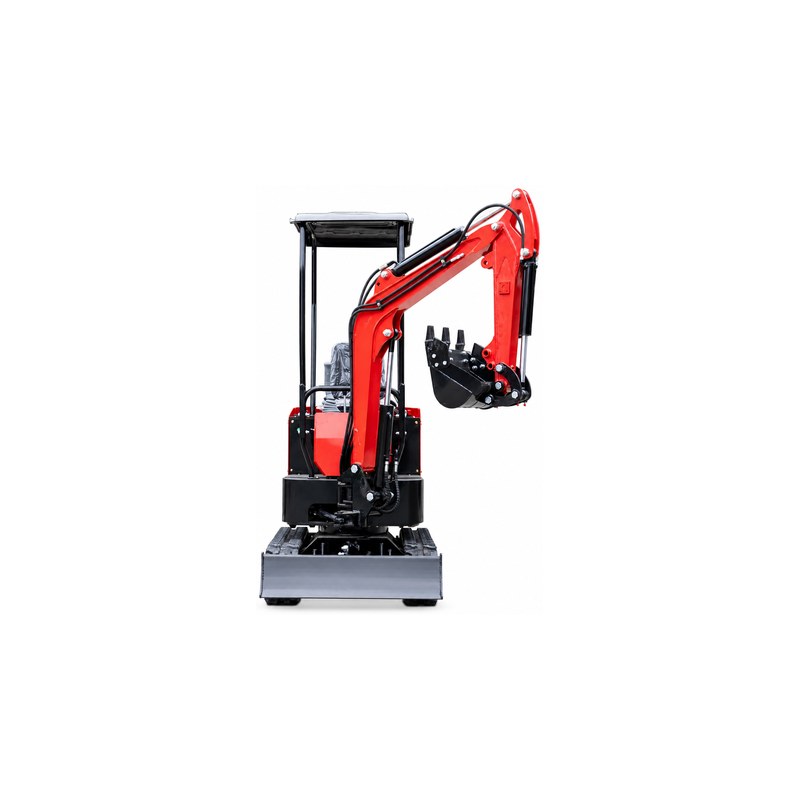
A one-ton excavator becomes more versatile when it can use different attachments, but compatibility depends on machine geometry, attachment mass, hydraulic requirements and coupler dimensions.
Buckets
A narrow trenching bucket reduces the amount of soil removed when installing pipes or cables. A wider bucket can improve surface cleaning and handling of loose material, but it also increases resistance and the amount of material carried in each cycle.
The standard HT10B bucket is 380 mm wide with a listed capacity of 0.025 m³. Alternative bucket dimensions should be selected according to soil type, trench width and machine capacity.
Hydraulic Breakers
A hydraulic breaker may be used for light concrete or rock work when the excavator’s auxiliary hydraulic circuit is compatible. Flow, pressure, hose routing, attachment weight and tool size must be checked before installation.
A breaker that is too large can reduce stability and place unnecessary stress on the boom, pins and hydraulic system.
Augers
Augers support fence-post holes, planting and selected foundation work. Soil condition has a major influence on performance because compact soil, stones and roots increase torque demand.
Before choosing an auger, confirm drive-unit requirements, bit diameter, expected drilling depth and the excavator’s hydraulic specifications.
Grapples and Other Tools
Grapples can assist with branches, stones and irregular materials. Rippers, grading buckets and other tools may also extend the working range of a small excavator.
Attachment availability and compatibility should be confirmed before ordering. Mingyang’s OEM and ODM machinery services cover engine options, attachments, colors, branding, labels and packaging for different markets.
1 Ton vs Larger Mini Excavators
A one-ton machine should be selected because its capacity matches the work—not only because it is easy to transport.
| Selection factor | 1 ton mini excavator | 2–3.5 ton mini excavator |
|---|---|---|
| Narrow access | Strong advantage | Requires wider access |
| Transport convenience | Generally easier | Requires greater transport capacity |
| Ground disturbance | Usually lower | Higher machine weight and ground load |
| Digging depth | Suitable for light and shallow work | Better for deeper trenches and foundations |
| Lifting stability | Limited by compact footprint | Greater stability for heavier loads |
| Attachment capacity | Best for lighter tools | Supports more demanding attachments |
| Production volume | Suitable for small projects | More efficient for sustained excavation |
| Confined-area control | Highly practical | Depends on width and tail-swing design |
A landscaping contractor working through narrow residential gates may benefit from a one-ton machine. A contractor repeatedly excavating deep utilities or handling heavy materials will generally need a larger model.
Mingyang’s mini excavator range also includes 1.3-ton, 2-ton, 2.15-ton and 3.5-ton models, allowing the machine size to be compared with the project rather than forcing one model into every application.
Transport and Jobsite Preparation
Operating weight is central to transport planning, but it is not the only figure that matters. The combined transport load may include the excavator, bucket, spare attachments, fuel, ramps and other equipment.
Before transport, confirm:
- The actual machine weight in the ordered configuration
- Trailer and transport-vehicle rated capacities
- Machine length, width and height
- Ramp capacity and loading angle
- Approved tie-down points
- Local transport and licensing requirements
- Attachment position during transport
At the jobsite, inspect the access route, soil condition, overhead clearance, slope, underground utilities and space required for upper-structure rotation. A compact machine can enter a narrow location, but it still requires a controlled work zone.
Daily Inspection and Maintenance Priorities
Compact equipment should not be treated as maintenance-free. Restricted spaces may expose hoses, tracks and body panels to walls, stones and site debris.
A practical daily inspection should include:
- Engine oil, coolant and fuel levels
- Hydraulic oil level and visible leakage
- Hoses, fittings and cylinder condition
- Track tension, track damage and undercarriage debris
- Bucket teeth, pins and retaining hardware
- Dozer blade and attachment connections
- Warning devices and operating controls
- Grease points around the boom, arm and bucket linkage
Clean service access and reliable replacement-parts identification can help reduce downtime. Mingyang’s after-sales service includes technical communication, spare-parts assistance, operation guidance and equipment support.
Questions to Answer Before Ordering
A useful equipment inquiry should include more than the required machine tonnage. Supplying detailed operating information allows the manufacturer to recommend a more appropriate configuration.
Before requesting a quotation, prepare:
- The narrowest access width and height
- Required digging depth and trench width
- Soil or material type
- Typical working slope
- Required bucket and powered attachments
- Destination country and engine requirements
- Expected daily operating hours
- Preferred engine configuration
- Branding, color and packaging requirements
- Spare-parts and documentation needs
This information helps determine whether a 1 ton mini excavator is sufficient or whether a heavier model would provide better long-term productivity.
FAQ
Is a 1 ton mini excavator large enough for foundation work?
It can support shallow footing trenches, drainage and light site preparation where the required depth and soil resistance remain within the machine’s capability. It is not the appropriate choice for every structural foundation. Excavation depth, soil condition, trench width and material-handling requirements must be checked before selecting the machine.
Can a one-ton mini excavator pass through a standard garden gate?
Some models are designed for narrow access, but the gate must be measured rather than judged visually. The HT10B has a chassis width of 896 mm and an adjustable track gauge of 830–1,000 mm. Clearance must also account for the blade, upper structure, uneven ground, corners and any obstacles along the complete access route.
What digging depth can I expect from a 1 ton mini excavator?
Digging depth varies by boom and arm geometry, even among machines with similar operating weights. The HT10B has a listed maximum digging depth of 1,650 mm and a maximum vertical digging depth of 1,375 mm. The project depth, working position and ground condition should be compared with these specifications before selection.
Which attachments can be used with a small excavator?
Common options may include trenching buckets, grading buckets, augers, rippers, grapples and light hydraulic breakers. Compatibility depends on attachment weight, pin or coupler dimensions, hydraulic flow, pressure and machine stability. The complete attachment specification should be confirmed with the manufacturer before production or installation.
Should I choose a 1 ton or 2 ton mini excavator?
Choose the one-ton class when narrow access, lower transport weight and precise light excavation are the main priorities. A two-ton model is generally more suitable when deeper digging, heavier material handling, greater stability or more demanding attachments are required. The correct choice should follow the project workload rather than machine size alone.
Conclusion
A 1 ton mini excavator is most valuable when it solves a genuine access problem without falling below the project’s required digging and lifting capability. The decision should start with the narrowest access point, followed by digging depth, excavation radius, unloading height, stability, engine configuration and attachment requirements.
The HT10B combines a 1,000 kg operating weight, 896 mm chassis width, adjustable 830–1,000 mm track gauge and 1,650 mm maximum digging depth. Its adjustable blade, optional swing boom and configurable engine choices support landscaping, farm maintenance, utility trenching and light construction in restricted areas.
For an accurate configuration, the intended application, destination market, attachment list and site dimensions should be provided before ordering. This allows the machine, engine and optional equipment to be matched to actual operating conditions rather than relying on tonnage alone.